

A technology overview for IT administrators, security officers, and developers — covering remote device access, intelligent local automation, and programmatic device orchestration.
Platform Overview
Three Products. One Integrated Platform.
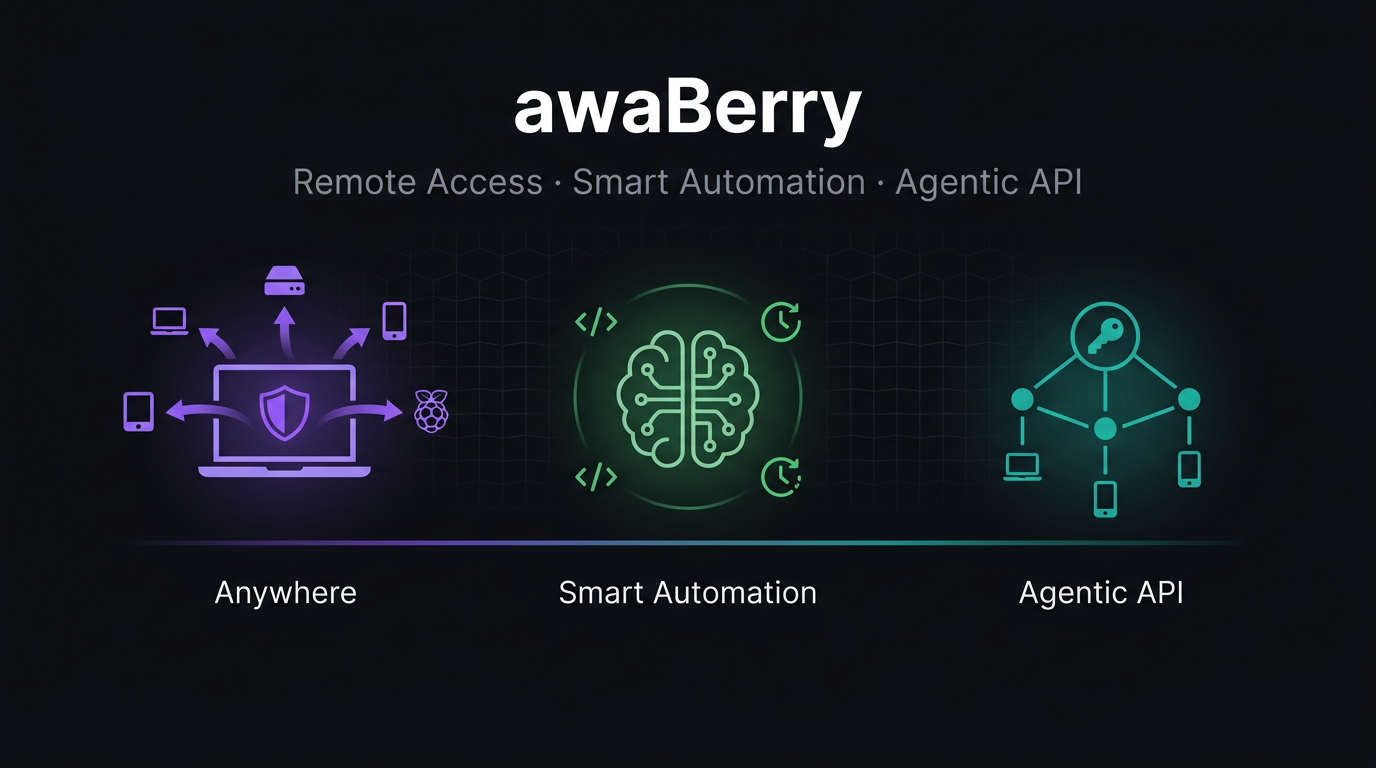
awaBerry is an integrated platform of three complementary products that together deliver remote device access, intelligent local automation, and programmatic device orchestration — all built on a zero-trust security foundation. It is designed for teams and individuals who manage distributed devices, run repetitive workflows, or need secure access to infrastructure without the overhead of VPNs, open firewall ports, or custom middleware.
awaBerry Anywhere
Zero-trust remote access: RDP, VNC, SSH, Web-to-Local tunnels, and file transfer — to any device, from anywhere, without VPN or open inbound ports.
Smart Automation Platform
AI-generated, locally executed automation scripts for any recurring task — described in plain English, generated once, running forever at zero marginal AI cost.
Agentic API
Programmatic and user-scoped device access via authenticated API projects — with four-dimension permission control and instant revocation.
For IT Administrators
Centralized Device Management Without VPN Infrastructure
Register any device — Windows, macOS, Linux, SoC hardware, Docker container — into a single web dashboard at app.awaberry.com. Full remote desktop (VNC/RDP), SSH, Web-to-Local tunnels, and drag-and-drop file management — no firewall rules needed, no public IPs required.
Fleet Automation Without Manual Scripting
Describe maintenance tasks in plain English. The AI engine generates production-ready scripts: real-time log anomaly detection with Slack/PagerDuty alerting, automated database backups with integrity validation and GPG encryption, and scheduled fleet maintenance across every machine. Zero AI tokens consumed at runtime.
Explore Smart Automation →Programmatic Fleet Orchestration via the Agentic API
A single Agentic API project can target multiple devices simultaneously. One authenticated API call deploys an update, pulls logs, or triggers a script across the entire fleet. Permissions are scoped per project — specific directories, specific commands, standard user or root — configured once, enforced at every execution.
Explore Agentic API →For Security Officers
Zero-Trust by Default
awaBerry Anywhere operates on a no-inbound-port model. The agent on each device establishes an outbound HTTPS tunnel to the awaBerry cloud coordination layer. Nothing reaches inward. No device is exposed to the internet. Every access pathway — human, automated script, or AI agent — is authenticated via a unique Project Key and Secret. No shared credentials. No standing sessions.
Granular Access Control
Every Agentic API project enforces four independent dimensions of least-privilege access: privilege level (standard user or root), filesystem access (named paths or all folders), write permissions (read-only or write), and command execution (allowlist or all). No dimension inherits from another.
Guest users accessing shared devices land in an isolated awaberry system account. Access is revoked instantly by deleting the project — no residual credentials, no account cleanup, no firewall reversal.
Compliance-Relevant Capabilities
Read-only audit access: Scope a project to specific log directories with no write access and a read-only command allowlist. Revoke when the audit ends.
Privileged Access Management: Replace shared root passwords with per-task API projects, each with a strictly bounded blast radius.
Contractor access: Share a Project Key, delete the project when the work is done. No VPN provisioning, no SSH key exchange.
Backup Integrity & Data Security
Backup pipelines validate their own output: each run performs row-count integrity checks before proceeding to compression, GPG encryption, and cloud sync. If any step fails, the pipeline aborts and fires an alert rather than uploading a corrupt file.
Encrypted archives are stored in operator-controlled cloud storage (Cloudflare R2, S3-compatible) with operator-managed GPG keys. awaBerry never holds encryption keys or backup data.
For Developers & DevOps Engineers
Your Local Environment, Reachable Everywhere
Remote Access to Local Compute
Remote desktop to a GPU workstation or build server — full VNC or RDP, native client, low latency. Web-to-Local tunnels expose localhost:3000, a local Jupyter server, or an internal dashboard as a secure URL — no port forwarding, no static IP required. Docker deployment integrates cleanly into containerized stacks with no host OS modification.
AI Agents With Hands — MCP Server Integration
The Agentic API integrates directly as an MCP (Model Context Protocol) server in agentic AI workflows. AI agents authenticate with a Project Key and gain secure, permissioned access to local machines — execute pre-approved commands, read input data from scoped directories, write results back, and chain calls across multiple machines.
Explore Agentic API →Automation That Generates Its Own Scripts
Describe tasks in plain English. The Setup/Execution split is architecturally enforced: a high-capability reasoning model (Gemini Pro) writes and validates the script once; the script then runs locally on schedule with no AI calls and no token cost — indefinitely. Nightly validated database backups, real-time log anomaly detection, automated data ingestion pipelines — all described in natural language.
Explore Smart Automation →Summary
One Platform. Three Persistent Infrastructure Challenges Solved.
awaBerry offers a unified answer to getting to your devices, automating what runs on them, and controlling who can do what. For IT administrators it replaces VPN sprawl with a managed dashboard. For security officers it replaces implicit trust with granular, revocable, least-privilege access. For developers it removes the friction between local compute power and wherever work actually happens.